Lithuanian A2 1,605 words for the Lithuanian state language exam — with audio, stress marks and Lithuanian-language definitions.
- 1,605 words
- 3,210 cards
- 6,420 recordings
- 18 themes
- 475 hand-checked paradigms
Two cards per word
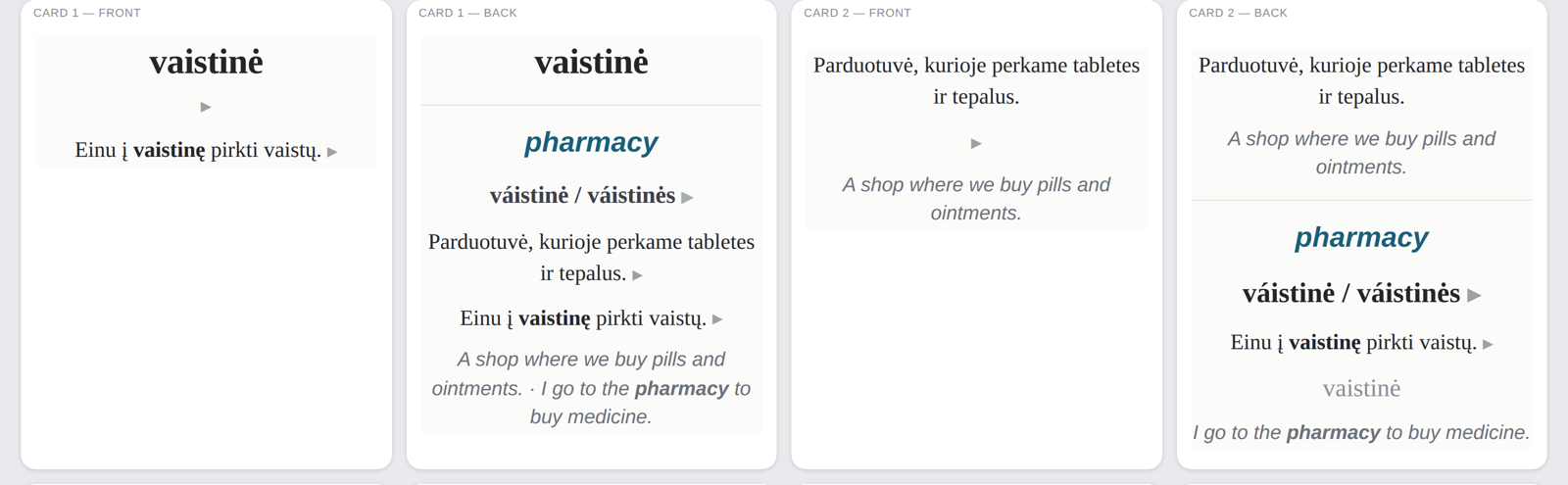
Every word makes a recognition card and a production card. The second one is the point of the deck: a definition written entirely in Lithuanian asks you to produce the word, which is why no definition ever contains the word it defines.
What's on a card
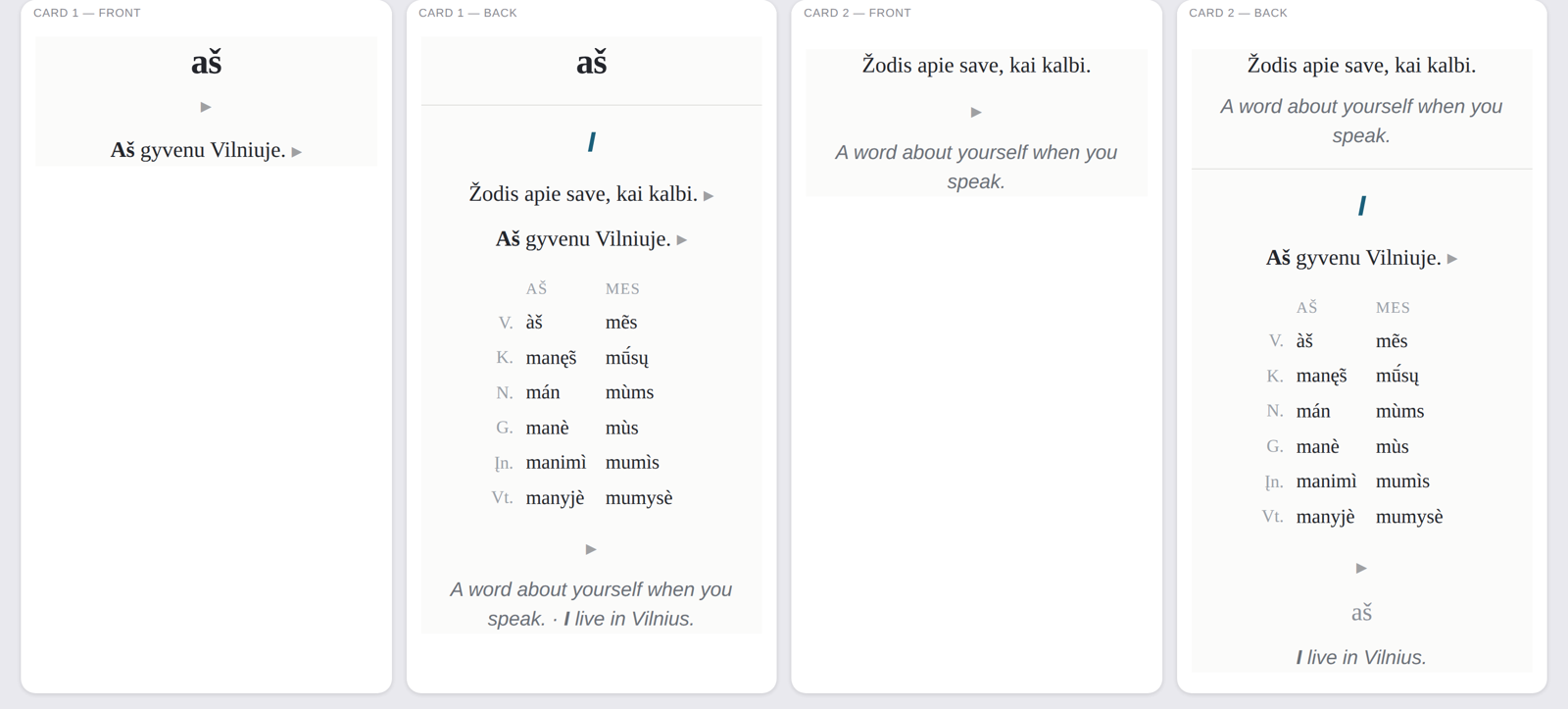
- Audio on everything — the headword, its inflected forms, the Lithuanian definition and the example sentence. Four recordings per word.
- Stress marks (kirtis) on headwords and on the inflected forms shown, not just the dictionary form.
- Inflected forms on every card: nouns with the plural, verbs with 3rd person present and past, adjectives with the feminine.
- Full case tables for the personal pronouns and demonstratives, voiced — including the feminine column that most decks leave out.
- The target word is bolded in the English translation, so it is obvious which word the sentence is teaching.
- Tags for everything —
tema::,pos::,batch::— so you can build a filtered deck of just the verbs, or just the food theme.
Eighteen themes, exam topics first
The first twelve are the twelve topics of the Ministry of Education's A2 content description (A2 kalbos mokėjimo lygio turinio aprašas). Six more cover ground the deck needed but that description does not name.
- Asmens tapatybė 130
- Pastatai ir namai 102
- Gamta, regionas 109
- Kasdienis gyvenimas 118
- Laisvalaikis 124
- Kelionės 104
- Santykiai su žmonėmis 134
- Sveikata ir higiena 130
- Švietimas ir mokslas 56
- Prekyba 114
- Maistas ir gėrimai 121
- Paslaugos 43
- Darbas ir profesijos 27
- Laikas ir orai 60
- Skaičiai ir įvardžiai 90
- Spalvos ir savybės 83
- Valstybė ir visuomenė 31
- Kalba ir gramatika 29
Getting it
Download the .apkg from the
latest release
and open it with Anki, or import it from within Anki:
File → Import. It arrives as Lietuvių A2 with a subdeck per theme.
Studying for recognition only? Suspend the second card type — it roughly halves the workload, and it is much the harder half.
How it was made
Honestly, and with the seams showing:
- The word list follows the A2 syllabus and the vocabulary of Pusiaukelė (Ramonienė et al.) and Nė dienos be lietuvių kalbos.
- Inflected forms and stress marks come from English Wiktionary, the VDU Kirčiuoklis stress tool and the
phonology_enginelibrary, cross-checked against each other. Every form is verified against the hunspelllt_LTdictionary. - Definitions, examples and translations were written with AI assistance and checked by automated rules — no headword inside its own definition, an inflected form in every example, restricted vocabulary, spell-checked throughout. They have not been proofread by a native speaker.
- The audio is synthesised, not recorded: the Lithuanian synthesiser operated by UAB Intelektika, voice “astra”, built on the publicly funded LIEPA project.
Intelektika's terms of use state that “Mūsų suteiktų Paslaugų rezultatus galite naudoti tiek asmeniniais, tiek komerciniais tikslais” — the results of the service may be used for personal and commercial purposes. No attribution is required; the credit below is courtesy.